
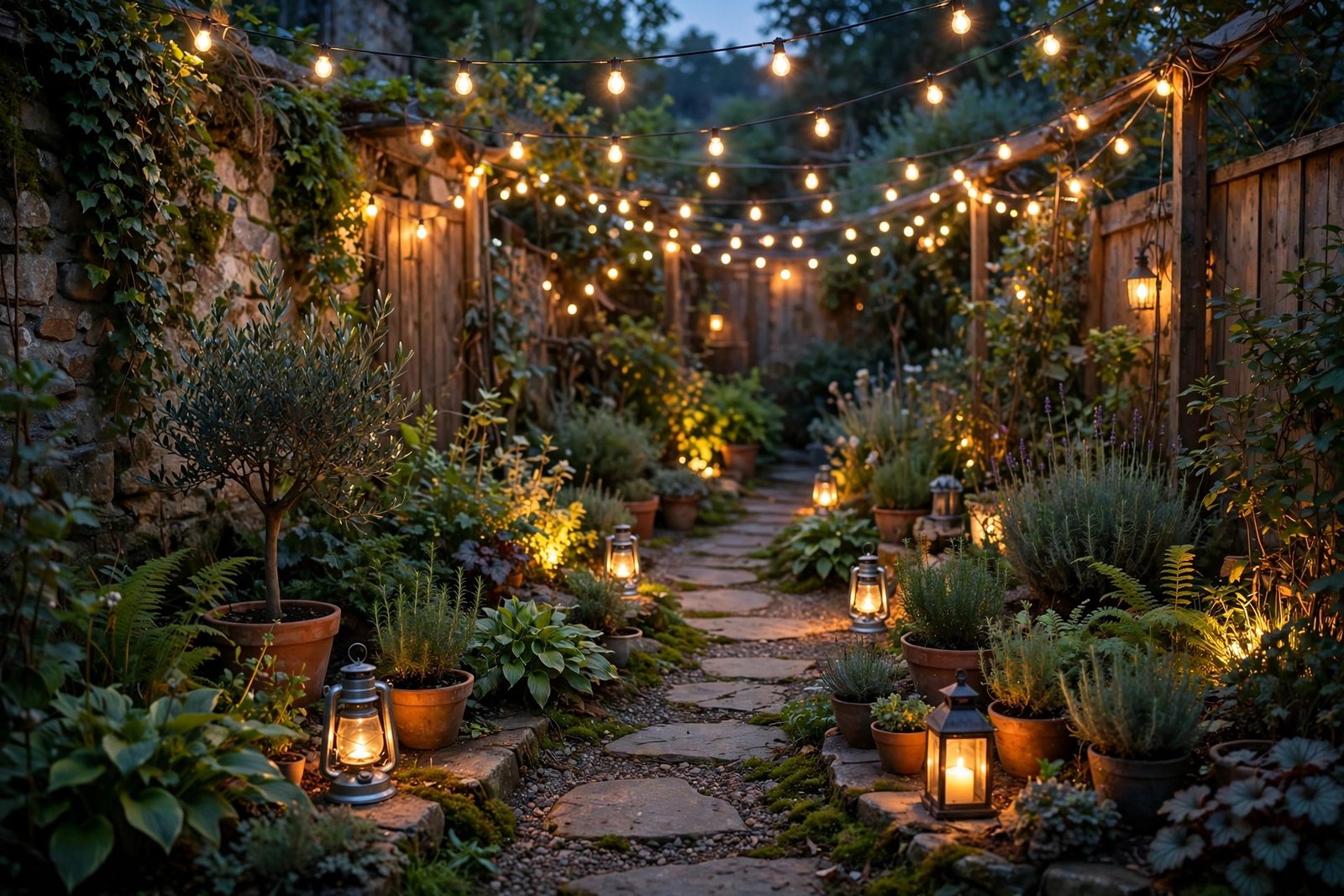
A small garden can feel completely different after sunset. Without light, the plants, path, and seating fade into darkness and the space goes unused. With a few well-placed lights, the same yard becomes warm and easy to enjoy for much longer. You do not need a big budget or complicated wiring: a handful of solar-powered, low-voltage, or battery-powered lights is enough to create a soft glow, highlight favourite plants, and make paths and steps safer.
Quick Answer
Combine three kinds of light: soft background light for general glow, task light where you sit or walk, and accent light for one or two favourite plants. Start with solar stake lights along the path, add string lights or lanterns near seating, and finish with one gentle uplight under a small tree. Choose warm white light, use only outdoor-rated solar, low-voltage, or battery-powered lights, and keep brightness low. If you ever want mains-powered lighting, it must be installed by a qualified electrician — never attempt mains wiring yourself.
Planning Layers of Light
Good garden lighting is rarely about one bright light. It is about small amounts of light in different places, which avoids dark corners and glare and makes a small space feel larger.
- Ambient light: a gentle overall glow, from string lights overhead, lanterns on a table, or solar lights around the edges.
- Task light: clearer light where you need to see well — on steps, along a path, beside a door, or over a table.
- Accent light: a focused glow on something beautiful, like a small tree, a pot of ornamental grass, or a textured wall.
Two or three lights per layer may be enough. Place them, wait until dark, and move them a little at a time until nothing shines directly into your eyes.
Choosing Warm vs Cool Light
Warm white light has a soft yellow tone, similar to candlelight. It flatters green leaves, wooden fences, terracotta pots, and skin tones, and is usually the best choice for a relaxing garden. Cool white has a bluer, crisper tone. It can suit grey stone and modern paving, but in a planted area it often feels stark and makes foliage look flat.
For a cosy glow, choose warm white for almost everything and keep the colour consistent. If a product lists a colour temperature, warm options are usually around 2,700 to 3,000 Kelvin. Prefer softer lights over very bright ones — in a small space, gentle light travels a long way.
Solar Path and Stake Lights
Solar stake lights are often the best starting point. Each has a small solar panel, a rechargeable battery inside, and a spike that pushes into soil or a large pot. They charge during the day and switch on automatically at dusk, with no cables to run, so they suit renters and beginners well.
Push stakes along a path, but stagger them rather than placing them in perfect pairs like a runway. A gentle zigzag looks more natural and still marks the route. Single stakes in flower beds can also pick out foliage or define a border edge.
Put the panel where it receives direct sun for several hours a day — a light under a dense shrub will glow only weakly. Wipe panels clean every few weeks, as dust and pollen reduce charging. In seasons with short or cloudy days, expect shorter run times; this is normal.

String and Festoon Lights Over a Patio or Between Trees
String and festoon-style lights create instant atmosphere overhead. Draped over a patio, strung between two trees, or fixed along a fence or pergola, they provide the ambient layer that makes people want to stay outside longer. Battery-powered and solar-powered versions need no outdoor socket.
Hang the line so it sags in soft swags rather than pulled tight. Keep bulbs above head height, and keep the cable off paths where someone could catch it. On a tree, use soft ties and check them so they do not cut into bark. One or two strands are usually enough.
The same approach works at the front of the house, where a short strand or a pair of lanterns can make an entrance feel welcoming. The ideas in this guide to styling a cosy front porch with plants pair naturally with soft lighting around the door and steps. Keep porch lighting warm and low so it guides visitors without dazzling them.
Lanterns and Battery Lanterns
Lanterns give you flexible light exactly where you want it. Battery-powered lanterns made for outdoor use, including styles that look like candles inside glass jars, give a steady or flickering glow without an open flame — safer around dry leaves, children, and pets, and they will not blow out in a breeze.
Group lanterns in odd numbers — a cluster of three on a table or beside a bench looks balanced. Mix heights: one taller lantern on the ground, a smaller one on a stool. Because they are portable, you can carry the light with you.

Uplighting a Tree or Feature Plant
Uplighting means placing a small light low down and aiming it upward into a plant. It reveals shapes you barely notice in daylight: the branches of a small tree, the arching leaves of a fern or grass, or the texture of bark. A single solar or low-voltage spotlight is often enough, and one feature lit gently looks far better than many plants lit brightly.
Set the light a short distance from the base and angle it so the beam washes up through the foliage. If you can see the bare bulb, hide it behind a stone or pot. Avoid aiming lights into neighbouring homes.
Lighting Steps and Edges for Safety
Safety is the most practical reason to add light. Steps, level changes, path edges, and door thresholds are easy to misjudge in the dark. Low, downward-facing lights solve this without flooding the garden. Solar step lights, small battery lights fixed to a riser, or stake lights placed right at an edge all work well.
Place a light at every change of level, not just at the top, and where a path turns a corner, so you have a clear, even route. Avoid bright ground lights that shine upward into the eyes, as glare makes steps harder to see.
Fairy Lights in Shrubs and Small Corners
Fairy lights — long strings of tiny points of light — add magic in small doses. Wind a battery-powered string loosely through a shrub, around a small tree trunk, or along a trellis. Keep the wiring loose so it does not constrict stems, and reposition it as the plant grows. A sparse scattering looks like fireflies; a dense tangle can look messy and may stress the plant.
Tiny lights are also perfect at miniature scale, tucked among small plants and ornaments in a container scene. If you enjoy that idea, this guide to making a fairy garden in a pot shows how to build the miniature setting itself. Use a battery pack you can reach easily, and choose a set rated for outdoor use if the pot lives outside.
Keeping Lighting Wildlife-Considerate
Many creatures are active at night, including moths, frogs, hedgehogs, and bats in some regions. Bright light left on all night can disturb them. Wildlife-friendly lighting is also the prettiest and cheapest to run.
- Keep lights dim and low, and light only areas you actually use.
- Choose warm-toned light rather than blue-white light, which attracts and confuses more insects.
- Use timers, or switch battery lights off when you go inside, so the garden is dark for most of the night.
- Aim lights downward and shield bulbs so light does not spill into hedges and trees where animals shelter.
- Leave one corner of the garden completely unlit as a dark refuge.
Care and Safety Notes
Always check that any light, cable, or battery pack is rated for outdoor use, and follow the maker’s instructions. Keep solar panels clean and in sun. Replace rechargeable batteries when lights fade quickly, and recycle old batteries through a local collection point.
Bring delicate lanterns, fairy lights, and glass items indoors during storms or very severe weather, and check stakes after strong winds. Keep battery compartments dry, and store spare batteries away from children and pets. This guide covers solar, low-voltage, and battery options only. Any mains-powered lighting must be installed by a qualified electrician. Do not attempt to wire, extend, or alter mains fittings yourself.
Mistakes to Avoid
- Using one very bright light. A single harsh spotlight creates glare and deep shadows. Several soft lights look better.
- Mixing warm and cool light. Different tones side by side look accidental. Pick warm white and stay consistent.
- Placing solar lights in shade. Panels need direct sun to charge, or the glow will be dim and short-lived.
- Lining paths like a runway. Perfectly paired, even spacing looks rigid. Stagger lights for a softer effect.
- Lighting everything at once. If every plant is lit, nothing stands out. Choose one or two features.
- Leaving lights on all night. It wastes power, disturbs wildlife, and can annoy neighbours. Use timers or switch off.
- Attempting mains wiring yourself. Mains electricity outdoors is dangerous. Hire a qualified electrician.
Frequently Asked Questions
How many lights does a small garden actually need?
Most small gardens look complete with six to ten lights: a few along the path, one or two lanterns near seating, and one accent light. Start with fewer, and add one at a time only where you notice a dark gap.
Do solar lights work on cloudy days and in winter?
Yes, but with shorter run times. Panels still collect light on overcast days, just more slowly. Clean panels, a sunny position, and healthy batteries make the biggest difference. Battery lanterns are a reliable back-up in darker seasons.
Are battery and solar lights bright enough for steps?
For marking steps and edges, yes. You do not need strong brightness — you need a light right at the edge so the step is clearly defined. Use one light per step, aimed downward, and test the route yourself at night.
Can I leave outdoor lights outside all year?
Outdoor-rated stakes and robust lanterns can stay outside in most weather, but delicate glass and fairy-light sets last longer if you bring them in during severe storms and store them dry. Check seals and battery compartments each season.
Conclusion
A glowing small garden comes from a few thoughtful choices, not expensive fittings: layer soft light, choose warm tones, mark paths and steps, highlight one or two favourite plants, and keep brightness low for neighbours and wildlife. Solar, low-voltage, and battery lights make this simple and safe to try. For more ideas, browse the full Garden Decor, DIY and Outdoor Living collection and pick your next small project.
1 thought on “Small Garden Lighting Ideas That Make Your Yard Glow”